
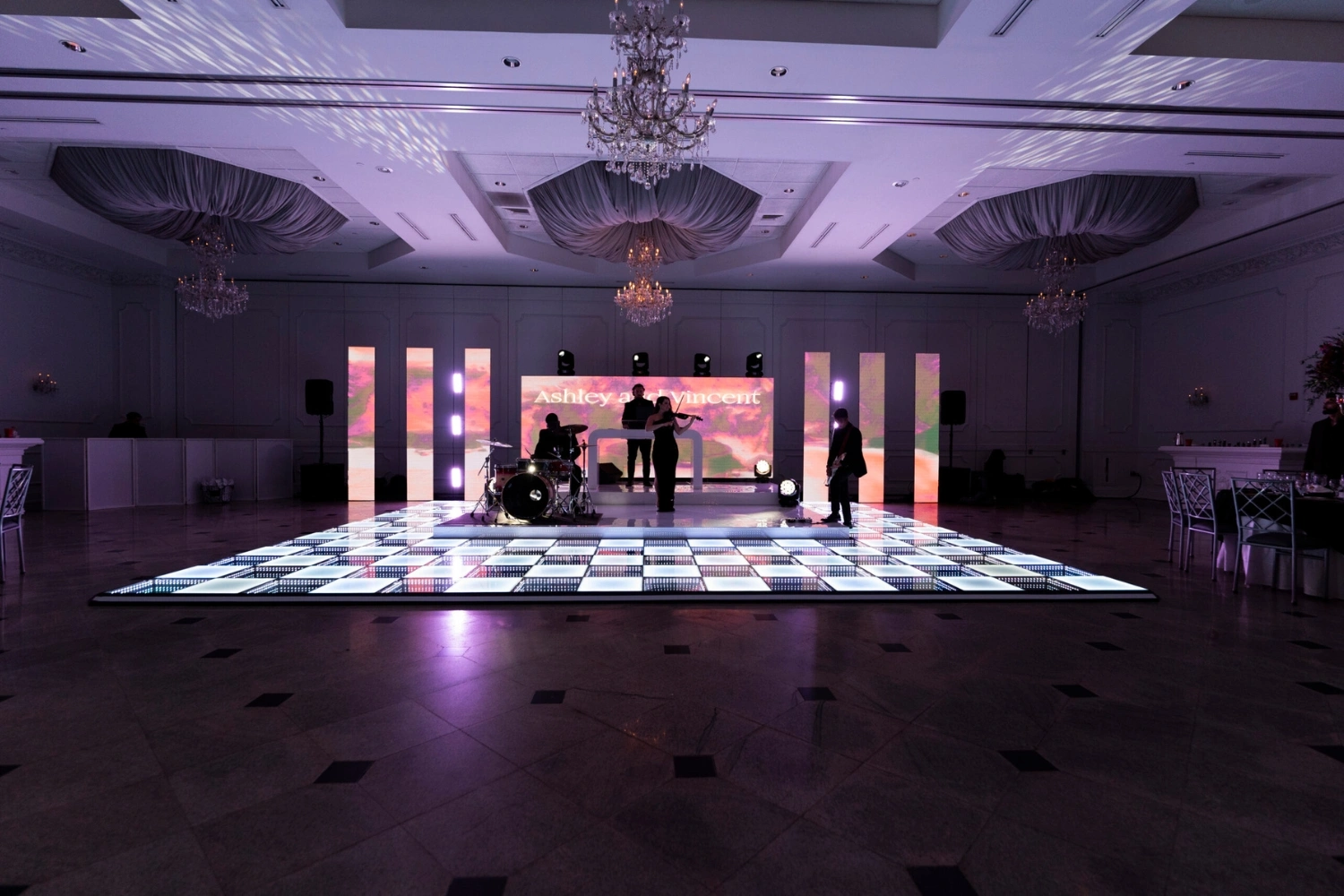
Interactive dance floors combine illuminated floor panels with sensing and control technology to create visuals that can react to guests in real time. Depending on the system, stepping or moving across the floor can trigger colors, patterns, animations, or other effects.
Not every LED dance floor is interactive. Some systems simply display programmed colors or lighting sequences without detecting where someone is standing or moving. Interactive systems add sensors or external movement detection that allow the visuals to respond to activity on the floor.
Behind the finished surface is a complete electronic system made from modular panels, structural supports, power connections, data connections, controllers, and display components.
For events where the dance floor itself is part of the experience, explore our dance floor rentals in New Jersey for professionally installed LED, Vinyl, and Static options.
This guide explains how interactive dance floors detect movement, create visuals, connect multiple panels, and control effects throughout an event.
What Makes a Dance Floor Interactive?
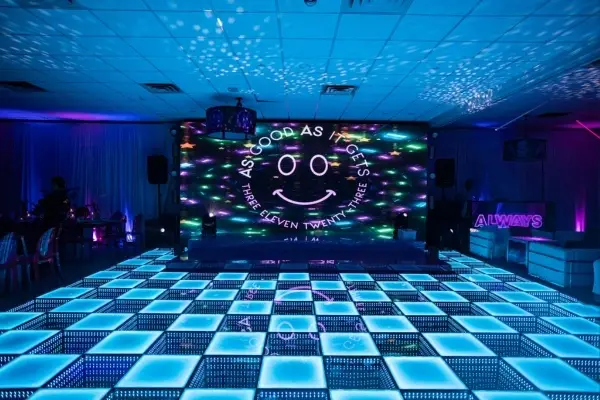
The main difference between a standard LED dance floor and an interactive dance floor is whether the system can respond to the people using it.
Standard LED Dance Floors
A standard LED dance floor can still create a dynamic visual experience.
Depending on the system, it may display:
- Solid colors
- Moving patterns
- Lighting sequences
- Color transitions
- Programmed effects
These effects can change throughout the event, but they do not necessarily react to where a guest steps.
A floor can therefore be illuminated and animated without actually being interactive.
Interactive LED Dance Floors
An interactive LED dance floor adds a way for the system to detect movement or activity.
When guests walk or dance across the floor, the system can use that information to change the visuals in real time.
Possible effects include:
- Lighting beneath a person’s feet
- Color changes
- Animated trails
- Ripples or expanding patterns
- Reactive graphics
- Effects that move with guests across the floor
The exact response depends on the floor, sensors, software, and visual capabilities of the system.
The basic distinction is simple: the display creates the visual effect, while the sensing technology creates the interaction.
How Do Interactive Dance Floors Detect Movement?
Interactive floors need a way to determine where activity is happening before they can respond to it.
Different systems handle that detection in different ways.
Pressure and Touch Sensors
Some interactive dance floors have sensors built directly into the individual panels.
When someone steps on a sensor equipped area, the system detects the location of that interaction. The information is sent to a controller, which determines what visual response should appear on the LED surface.
For example, stepping on one part of the floor might cause that section to illuminate or trigger an animation that expands into surrounding panels.
Because the sensing system is built into the floor, the response can closely follow where guests are walking or dancing.
External Motion Detection
Other interactive floors can use external movement detection rather than relying entirely on sensors inside the panels.
Radar and similar tracking technologies can detect where people are moving across an area and send that position information back to the control system.
This allows the floor to react to movement without requiring every interaction to be detected through direct pressure.
The exact technology varies by system, but the purpose is the same: determine where activity is happening so the display can respond appropriately.
How the Floor Responds
The interaction happens through a simple sequence.
- A guest steps or moves across the floor.
- The sensing system identifies the interaction.
- The controller receives the movement information.
- The system determines which visual effect should appear.
- The LED panels display the response.
This process happens quickly enough that the guest sees the floor react almost immediately.
The result can feel simple from the user’s perspective even though several electronic systems are working together underneath the surface.
How Do LED Dance Floor Panels Create the Visuals?
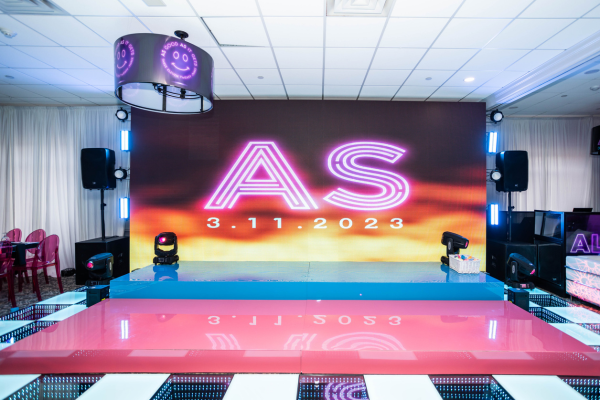
Once the system knows where someone is moving, the LED panels create the actual visual response.
LED Floor Panels
Interactive dance floors are typically assembled from modular illuminated panels.
Depending on the technology inside them, those panels may be capable of displaying:
- Solid colors
- Patterns
- Animations
- Graphics
- Text
- Video
Not every LED dance floor can display all of these.
Some floors are designed primarily for illuminated colors and patterns. More advanced LED screen floors can function more like large video displays and produce detailed graphics, branding, text, or video content.
That distinction matters when choosing a floor based on the visual experience you want to create.
How Multiple Panels Work Together
A large dance floor is not usually one giant display panel.
Instead, individual panels connect physically to create the walking surface and electronically so they can share power and display information.
The control system then treats those connected panels as one larger visual area.
That allows an effect to begin on one panel and continue onto another. A trail can follow someone across the floor, an animation can expand across several sections, or a pattern can cover the entire dance area.
Proper panel alignment is important because the finished floor needs to function both as a continuous walking surface and as a continuous visual display.
Resolution and Pixel Pitch
More advanced LED display floors also have a specification called pixel pitch.
Pixel pitch describes the distance between individual pixels in the display. Generally, a smaller pixel pitch allows the floor to reproduce finer visual detail.
That becomes more important when the floor needs to show:
- Logos
- Text
- Detailed graphics
- Branded content
- Video
A floor being used primarily for colors, glowing effects, and simple animations may not require the same level of detail as one being used as a full video display.
What is Inside an Interactive Dance Floor?
An interactive floor is more than a layer of lights underneath a transparent surface.
Each panel has to function as part of both an electronic display and a physical floor that guests can safely walk and dance across.
Structural Floor Panels
A typical interactive LED panel can contain several components inside one modular unit.
These may include:
- Structural housing
- Finished walking surface
- LED or display components
- Sensors where applicable
- Internal electronics
- Power connections
- Data connections
The structural portion protects the electronic components while creating the finished surface guests actually use.
The exact construction varies considerably between manufacturers and flooring systems.
Supports and Leveling
The panels also need a stable and consistent base.
Temporary LED floor systems may use adjustable feet, supports, frames, or other mounting components underneath the panels.
These components help create:
- Consistent panel height
- Proper alignment
- A level finished surface
- Stable connections between panels
This becomes especially important as the floor gets larger. Even small differences in panel height or alignment can become noticeable when many modules are installed next to one another.
The surface underneath the LED floor also matters. Ballroom flooring, concrete, platforms, and other venue surfaces can create different installation conditions.
Power and Data Connections
Interactive dance floors need both power and information.
Power connections supply electricity to the LEDs, sensors, controllers, and other electronic components.
Data connections carry the instructions that tell each panel what it should display.
A complete system may therefore include:
- Power cables
- Signal cables
- Controllers
- Receiving hardware
- Power distribution equipment
The panels may look simple once everything is assembled, but behind the finished surface is a network of connected electronic components working together.
How Are Interactive Dance Floors Controlled?

The control system determines what the floor displays and how those visuals behave throughout the event.
The exact controls depend on the capabilities of the flooring system.
Computer and Software Control
Many advanced LED floors can be managed through computer software.
Depending on the system, an operator may be able to:
- Select visual effects
- Change colors
- Trigger animations
- Upload graphics
- Adjust brightness
- Manage branded content
- Change interactive behaviors
Software control is especially useful when the floor needs to display custom graphics or change its appearance at specific moments during an event.
DMX Control
Some interactive and LED dance floor systems can also support DMX control.
DMX is a control protocol commonly used throughout professional event lighting. It allows compatible equipment to receive instructions from a centralized control system.
When a dance floor supports DMX, its effects may be coordinated with other production elements such as:
- Stage lighting
- Room lighting
- Music cues
- Visual effects
This can help the floor feel like part of the complete event production rather than a separate illuminated surface operating on its own.
Programmed, Live, and Interactive Effects
There are also important differences between how effects are triggered.
- Programmed effects follow sequences prepared in advance. The floor might cycle through predetermined colors, patterns, or animations.
- Live controlled effects are changed by a technician during the event. The operator can respond to different moments by selecting new visuals or adjusting the floor in real time.
- Interactive effects respond directly to guest movement detected by the system.
These methods are not necessarily exclusive. A capable floor may use programmed effects during one part of an event, live control during another, and interactive effects once guests begin dancing.
What Can an Interactive Dance Floor Do?
The exact capabilities depend on the floor system, but interactive floors can do much more than simply light up.
Respond to Footsteps and Movement
Interactive effects can react directly to where guests walk or dance.
Common examples include:
- Illuminated footsteps
- Color changes
- Ripples
- Light trails
- Reactive floor tiles
The effect can appear beneath a guest, follow their movement, or spread across nearby panels.
Display Patterns and Animations
LED dance floors can also display programmed visual effects such as:
- Geometric patterns
- Moving graphics
- Color transitions
- Animated sequences
These can run continuously or change throughout different parts of the event.
Display Logos and Branded Content
More advanced display floors can incorporate custom graphics and branding.
This can be useful for:
- Corporate events
- Product launches
- Brand activations
- Sponsor displays
A company logo, event graphic, or branded visual can become part of the floor itself rather than appearing only on signs or video walls.
Display Video or Detailed Graphics
Some interactive LED floors function more like full video displays and can show detailed graphics, text, or video.
Others are designed mainly for colors, patterns, and lighting effects.
The capabilities of the actual floor system should be confirmed before planning content around it.
Coordinate With Music and Lighting
An interactive floor can also become part of the larger event production.
Its visuals may be coordinated with:
- Music
- DJ performances
- Stage lighting
- Room lighting
- Other visual effects
This allows the dance floor to change with different moments of the event rather than operating as a separate element.
Frequently Asked Questions About Interactive Dance Floors
How Does an Interactive Dance Floor Know Where You Step?
Interactive floors can use sensors built into the panels or external movement detection systems. When movement is detected, that information is sent to the controller, which determines where the interaction happened and tells the LED display what visual effect to produce.
Are All LED Dance Floors Interactive?
No.
Some LED dance floors display programmed colors, patterns, and lighting effects without detecting guest movement. A truly interactive floor needs some form of sensing or tracking technology that allows the visuals to respond to what people are doing on the floor.
What Is Inside an Interactive LED Dance Floor?
Depending on the system, a panel may contain structural housing, a finished walking surface, LEDs or display components, sensors, internal electronics, power connections, and data connections.
The exact construction varies between manufacturers and floor systems.
Can Interactive Dance Floors Display Video?
Some can.
Advanced LED screen floors can display video, detailed graphics, text, and other digital content. Simpler LED dance floors may be limited to colors, patterns, and lighting effects.
Can Interactive Dance Floors Display Logos?
Yes, depending on the display capabilities of the system.
Floors capable of showing custom graphics can display company logos, event branding, sponsor graphics, names, or other designed content.
Do Interactive Dance Floors React to Music?
They can be coordinated with music, but movement detection and music control are separate functions.
Effects may be programmed around songs or controlled live while other interactive effects continue responding to guests on the floor.
How Are Interactive Dance Floors Controlled?
Control methods vary by system and may include computer software, dedicated controllers, DMX, remote control, or interactive sensing technology.
More advanced systems can use several control methods during the same event.
Do Interactive Dance Floors Require Power?
Yes.
LED panels, sensors, controllers, receiving hardware, and other electronic components require electrical power. Power distribution needs should be planned before installation.
Are Interactive Dance Floors Modular?
Many temporary interactive dance floors are modular.
Individual panels connect together to create the required floor size while also sharing power and display data across the completed surface.
Conclusion
Interactive dance floors combine sensing technology, control systems, and LED displays to create a floor that can respond to guests in real time.
Some systems detect footsteps through built-in sensors, while others use external movement detection. Modular panels then work together as one larger visual surface capable of producing colors, patterns, animations, graphics, and, on some systems, video.
The technology is only part of the setup. Floor size, venue surface, power, panel height, installation, and control requirements all need to be considered before the event.
For professionally installed LED, Vinyl, and Static options, explore One Of A Kind Events’ dance floor rentals in New Jersey.