
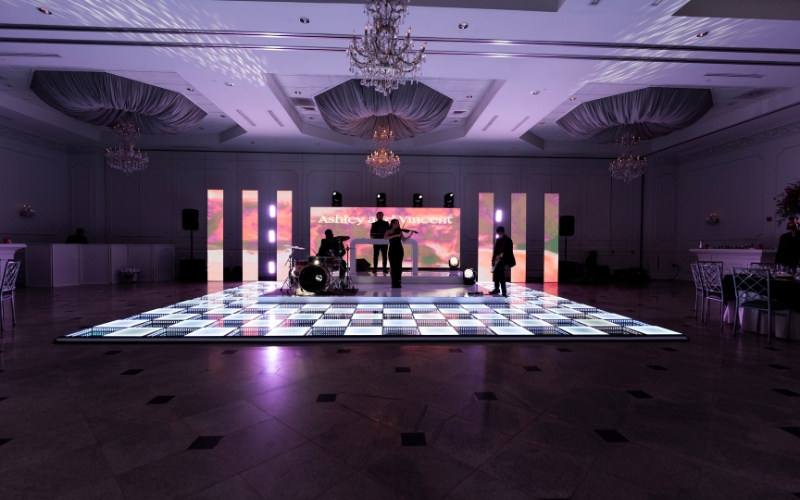
Couples spend a lot of time deciding where tables, bars, décor, photo booths, and other elements should go. The DJ booth sometimes ends up wherever there happens to be space left.
That can be a mistake.
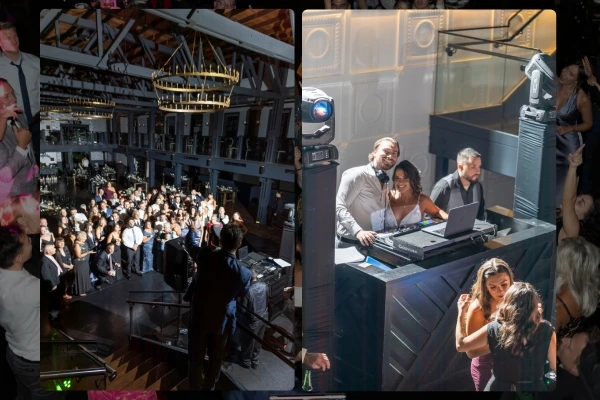
A wedding DJ does their best work when they are positioned directly next to the dance floor. From there, they can see how guests are responding, hear how the room sounds, communicate with the MC and production team, and react to the crowd in real time.
DJ placement is not just about convenience. It can directly affect how connected the entertainment feels to the dance floor.
Looking for experienced DJs in New Jersey? One Of A Kind Events plans the music, sound, MC services, production, and DJ setup around the way your reception actually needs to function.
The DJ Needs to See the Dance Floor
Want to see why DJ placement matters? Watch this wedding DJ POV from directly behind the booth, with the dance floor right in front of the DJ: Watch the video.
Professional wedding DJs do not simply press play on a predetermined playlist.
They are constantly watching the room.
A DJ may be paying attention to:
- How quickly guests respond to a song
- Which age groups are dancing
- Whether people are singing along
- Whether the floor is gaining or losing people
- How guests react when genres change
- Whether a song should play longer
- Whether it is time to transition
- Whether the energy needs to increase or settle down
Those small reactions help determine what happens next.
If the DJ is across the ballroom, behind guest tables, around a corner, or partially blocked by a wall or column, those reactions become harder to see.
That makes crowd reading more difficult than it needs to be.
Crowd Reading Happens in Real Time
The best music decisions are often made while the reception is happening.
A DJ might notice that a song is bringing more people onto the floor and let it breathe a little longer. Another song may clear part of the floor faster than expected, which tells the DJ it is time to transition.
Sometimes those decisions happen within a few minutes. Sometimes they happen within the same song.
A playlist created weeks before the wedding cannot tell the DJ what 150 guests are responding to at that exact moment.
The DJ needs to see it happening.
Distance Creates a Disconnect
There is a noticeable difference between a DJ being part of the entertainment area and a DJ operating from the opposite side of the room.
When the DJ is far away:
- Visual feedback becomes weaker
- Guest interaction becomes more awkward
- Requests and quick communication are harder
- Changes in crowd energy may be less obvious
- Communication with the MC can become more difficult
- The entertainment setup can feel visually disconnected from the dance floor
That does not mean a DJ positioned farther away will automatically ruin the reception.
It simply removes information and creates unnecessary separation between the person controlling the music and the people responding to it.
When the venue layout allows it, keeping the DJ close is the better setup.
The DJ Booth and Dance Floor Should Feel Like One Entertainment Area
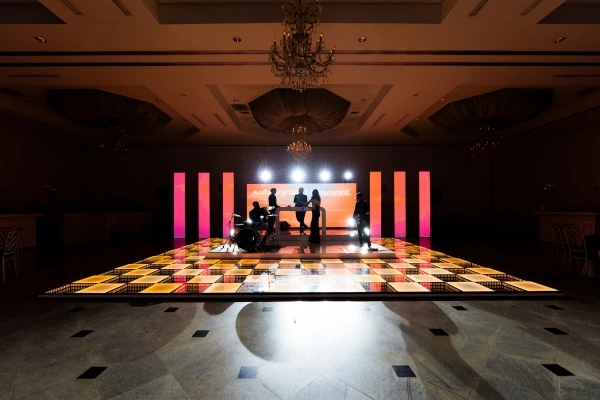
The DJ booth, speakers, lighting, and dance floor should generally feel like parts of the same entertainment zone.
When guests enter the reception, the layout should make sense.
Once open dancing begins, the dance floor becomes one of the main focal points of the room. Positioning the DJ directly beside it visually connects the music to the action.
A booth placed alone against a distant wall can make the room feel fragmented.
A booth positioned at the edge of the dance floor creates a more intentional entertainment area.
The DJ Booth Can Still Match the Wedding Design
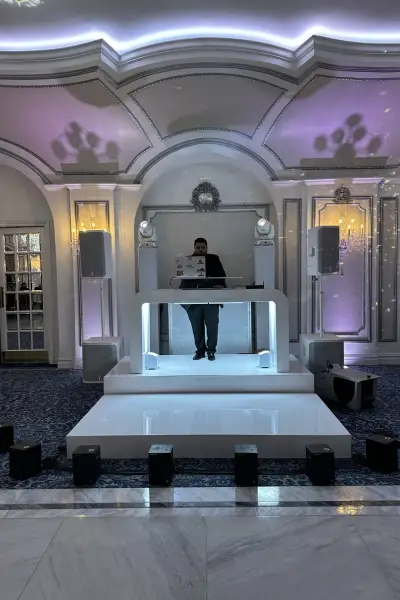
Being close to the dance floor does not mean putting an unattractive equipment table in the middle of the room.
A DJ setup can be designed to fit the wedding.
One Of A Kind Events offers custom DJ booths that can be incorporated into the overall look of the reception rather than treated as an afterthought.
Depending on the event, the booth can work with lighting, screens, monograms, finishes, and other design elements.
The important part is balancing appearance with function.
A beautiful DJ booth still needs to be positioned where the DJ can actually do the job well.
Speaker Placement Works Better Around the Dance Floor
The DJ booth does not determine every speaker location.
Larger ballrooms, unusual venue layouts, and more advanced productions may require speakers in several areas.
But putting the main entertainment setup near the dance floor creates a logical starting point for the audio design.
Dance music should primarily serve the dance floor.
That does not mean blasting the entire ballroom at the same volume.
Good speaker placement should consider:
- Where guests will be dancing
- Where dinner tables are located
- The shape of the room
- Venue acoustics
- Whether additional speakers are needed
- Where the DJ and MC are positioned
The goal is not simply to make the room louder.
The goal is to create appropriate sound coverage where it is needed.
The DJ Needs to Hear What the Crowd Hears
Wedding DJs also need to understand how the music sounds in the room.
Being near the dance floor gives them additional feedback on:
- Overall music level
- Vocal clarity
- Bass response
- Microphone levels
- How different songs are translating through the system
Professional DJs use monitoring equipment at the booth, but hearing the room itself still matters.
A track can sound one way through booth monitors and slightly different once it fills a ballroom.
Being positioned near the main entertainment area gives the DJ a better sense of the actual guest experience.
Guests Interact With the DJ Throughout the Night
Wedding receptions are not completely predictable.
Guests may approach the DJ with a request. A planner may need to adjust the timeline. The venue may need to communicate a change. A family member may have a special song that has already been approved by the couple.
Other quick conversations can involve:
- Special announcements
- Surprise songs
- Timeline changes
- Upcoming formalities
- Venue updates
- Requests from the couple
- Last-minute coordination with other vendors
Guests should not spend the entire night crowding the DJ booth.
But the DJ also should not be hidden somewhere that makes normal communication difficult.
Reasonable proximity makes those quick interactions much easier.
DJ and MC Communication Is Easier
Many wedding receptions involve both a DJ and an MC working together.
They need to stay coordinated throughout the night.
During Formalities
The DJ and MC may need to coordinate:
- Wedding party introductions
- First dance
- Parent dances
- Toasts
- Cake cutting
- Special performances
- Open dancing
- Last dance
The MC may be speaking while the DJ is preparing the next music cue.
Timing matters.
If the two are positioned near each other, communication becomes much easier.
During Open Dancing
That coordination continues after the formalities are over.
The DJ and MC may need to discuss:
- Upcoming announcements
- Crowd energy
- Timeline adjustments
- Venue timing
- Special requests
- When the final songs should begin
The physical setup should support that teamwork instead of making it harder.
The DJ Needs a Clear View of the Couple
The dance floor is not the only thing the DJ watches.
The couple matters too.
Throughout the reception, the DJ may need to know whether the couple is:
- Ready for the next formality
- Talking with guests
- Outside taking photos
- Preparing for a special dance
- Temporarily out of the room
- Ready to open the dance floor
Starting a major moment when one half of the couple is missing creates an awkward situation.
A clear line of sight helps the DJ and MC understand what is happening without constantly chasing people down.
Why Putting the DJ Behind a Wall or Around a Corner Is a Problem
Some venue layouts make DJ placement harder than others.
When possible, avoid placing the DJ:
- In a separate room
- Around a corner
- Behind a structural column
- Behind a wall or partition
- Far behind guest tables
- On an elevated platform with a poor view
- Somewhere guests cannot easily identify as the entertainment area
The biggest problem is usually visibility.
If the DJ cannot clearly see the dance floor, they lose some of the immediate feedback they use to make music decisions.
Some venues have physical limitations that cannot be changed.
In those situations, the answer is not to ignore the problem. The DJ, venue, planner, and production team should work together to create the best setup possible within the room.
Should the DJ Be on a Stage?
Sometimes.
A wedding DJ can work from floor level or from a properly sized stage.
Being elevated can help in a large ballroom or a more production-heavy setup, but a stage is not automatically better.
What matters more is:
- A clear sightline to the dance floor
- Reasonable proximity to guests
- Safe equipment placement
- Proper sound coverage
- Enough space for the DJ and MC
- A layout that works with the room
Putting the DJ on a stage at the opposite end of the ballroom does not solve a bad location.
Elevation is helpful when it supports the overall design. It should not come at the expense of connection with the dance floor.
How Close Should the DJ Be to the Dance Floor?
There is no universal measurement that works for every venue.
Ballrooms come in different sizes and shapes, and production setups can vary considerably.
Ideally, the DJ booth should be directly adjacent to or immediately beside the dance floor.
At the same time, there needs to be enough clearance for:
- Guests
- Speakers
- Lighting
- Production equipment
- Venue staff
- Service routes
- Safe walking paths
The goal is not to squeeze the DJ booth as close to the dancers as physically possible.
The goal is to keep the DJ connected to the dance floor while maintaining a safe and functional layout.
What If the Venue Has a Fixed DJ Location?
Some venues already have a preferred area where entertainment companies typically set up.
That can work perfectly well.
But it should still be evaluated instead of automatically accepted.
Ask:
- Can the DJ clearly see the entire dance floor?
- Is the booth unnecessarily far from guests?
- Are columns blocking the view?
- Where will the speakers be placed?
- Is adequate power available?
- Can the MC move easily around the room?
- Does the location interfere with guest tables?
- Does it interfere with venue service?
- Is there enough room for lighting and production?
A professional entertainment team can work with the venue ahead of the wedding to determine whether the default location actually works for the event being planned.
That conversation should happen before wedding day.
What Else Should Be Near the Dance Floor?
The DJ booth is only one part of the entertainment area.
Depending on the wedding, nearby elements may include:
- Primary entertainment speakers
- Dance-floor lighting
- Live musicians
- A band
- Special effects where permitted
- Production equipment supporting open dancing
Not every piece of equipment needs to surround the floor.
The goal is to create one cohesive entertainment area without making it crowded.
Frequently Asked Questions About Wedding DJ Placement
Where Should a Wedding DJ Be Positioned?
Ideally, the DJ should be directly beside or very close to the dance floor with a clear view of guests and the reception space.
Does the DJ Have to Be Next to the Dance Floor?
It is not an absolute requirement, but close placement gives the DJ better visibility, communication, and crowd feedback.
Should the DJ Booth Face the Dance Floor?
Generally, yes. A clear view of the dance floor helps the DJ monitor guest reactions and adjust the music in real time.
Should the DJ Be on a Stage?
Not always. A stage can work well for certain venues and production setups, but sightlines and proximity to the dance floor matter more than elevation alone.
Can Guest Tables Be Between the DJ and Dance Floor?
They can, but it is generally better to avoid creating unnecessary distance between the DJ and dancers when the floor plan allows.
When Should DJ Placement Be Decided?
DJ placement should ideally be discussed while the reception floor plan and production layout are being finalized rather than on the wedding day.
Keep the DJ Connected to the Dance Floor
Your DJ does not need to be next to the dance floor because they want attention.
They need to be there because the dance floor is giving them information all night.
The DJ can see which songs are working, notice when energy changes, communicate with the MC and production team, hear how the room sounds, and react without delay.
Good placement makes all of that easier.
One Of A Kind Events provides experienced DJs in New Jersey backed by an in-house team handling sound, lighting, custom DJ booths, event design, and production. We plan the entertainment setup around the room so the DJ is positioned to actually connect with the crowd from the first song through the end of the night.