
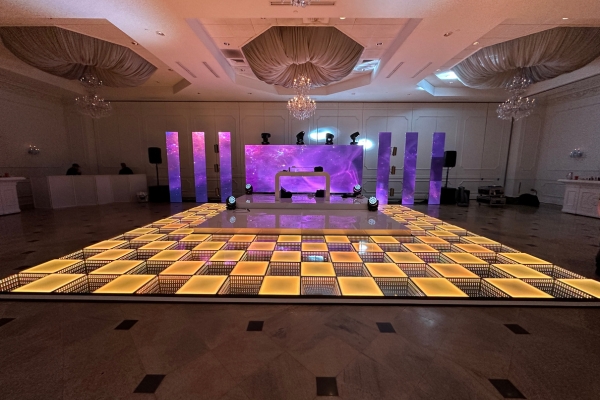
DJ booth placement isn’t just “where the table fits”: it affects how the entire reception feels. Put the DJ in the wrong spot and you’ll get volume complaints, dead zones on the dance floor, awkward traffic jams, and photos that quietly expose clutter in every wide shot.
Put the DJ in the right spot and everything gets easier: announcements land clean, transitions feel effortless, the dance floor fills faster, and the room sounds balanced instead of harsh. The rules are simple: prioritize sound coverage, sightlines, camera angles, and guest flow: and you’ll get a setup that looks intentional and performs better all night. If you want your booth placement to really land, pairing it with a custom event design ensures the entire room — not just the booth — feels intentional from every angle.
Check out our custom DJ booth rentals.
The goal of DJ booth placement
The DJ should control the room, not fight it
The booth should be positioned so the DJ can see the dance floor, the head table, entrances, and the main “moment zones” where things happen. If the DJ can’t see the room, they can’t read it: and if they can’t read it, timing slips and energy drops. The right placement keeps the DJ connected to the crowd without being swallowed by it.
A practical rule: the DJ should be able to make eye contact with key people (planner, venue captain, couple) without leaving the booth. That’s how you avoid awkward pauses and missed cues.
You want even sound, not “loud here, dead there”
Placement is the first step to making music feel consistent across the room. The dance floor should be the loudest zone: dinner tables should still be able to talk. When the booth is jammed in a corner or aimed the wrong way, sound bounces, echoes build, and guests start asking for constant volume changes: which kills momentum.
Think of sound like a blanket: you want smooth coverage across the floor, not hotspots that blast one table and leave another dead.
The DJ booth should look intentional in the wide shot
During intros, first dance, parent dances, and open dancing, cameras naturally point toward the dance floor. That means the DJ booth is in the background constantly. If it’s placed in a messy area, backed into a service corner, or surrounded by random venue clutter, it shows up forever: even if you didn’t notice it in real time.
A clean booth and clean background reads “premium” instantly in photos: and that matters.
The best DJ booth locations in most venues
Centered on the long wall: the “safe” layout
For most ballrooms and standard reception rooms, centered on the long wall is the most reliable setup. It creates symmetry, supports even sound coverage, and frames the dance floor cleanly. Guests also understand the room faster: they walk in, see the booth, see the floor, and the night feels organized.
This placement also tends to work best with lighting because you’re building a consistent focal direction for uplights, moving heads, and dance floor effects.
Opposite the head table: strong for weddings
Opposite the head table gives the DJ a direct line to the couple and the formalities. Intros feel tighter, toasts feel smoother, and the DJ can read reactions instantly. It also helps the room “face” the same direction during key moments, which makes the event feel more unified.
If your venue has a natural “front” of the room: this is usually it.
Near the dance floor, not on top of it
You want the DJ close enough to feel connected to the energy, but not so close that the booth becomes a traffic hazard. Give yourself a buffer so guests aren’t leaning on the setup, blocking sightlines, or clustering in a way that stops flow.
A simple guideline: leave a clear lane in front of the booth for movement and vendor access: and keep the booth close enough that the DJ can work the room without cranking volume to reach the floor.
DJ booth placement mistakes to avoid
In a corner: sound bounces and dies
Corners create weird reflections and uneven coverage. You get loud pockets near the booth, dead zones across the room, and constant volume complaints. Corners also visually shrink the setup: it feels tucked away instead of leading the room.
If you have no choice, you need intentional speaker placement and a booth that looks clean: but it’s still the “fight the room” option.
Behind a pillar, greenery, or drape
Anything that blocks visibility is a problem. The DJ loses the ability to read the dance floor, and the setup looks hidden. It also ruins content because the camera catches partial gear, weird angles, and background clutter.
If you’re hiding the booth because you don’t like how it looks: the real fix is upgrading the presentation, not burying it.
Blocking bars, exits, or service paths
This creates friction immediately. Staff needs clear movement lanes: guests need to get to the bar and bathrooms without bottlenecking: and venues care a lot about fire lanes. If the booth placement forces people to squeeze through a narrow gap all night, the room will feel annoying even if the music is great.
Too close to tables
When speakers are aimed at seated guests or the booth is right next to tables, people complain fast. You’ll end up turning music down during the exact window you need energy. It also makes the dance floor feel less inviting because the “party zone” bleeds into the dinner zone.
How placement affects sound
Walls, windows, and ceilings change everything
Ballrooms usually have controlled acoustics but can still echo if ceilings are high and walls are hard. Industrial spaces with brick, concrete, or glass will reflect sound harder: you’ll feel harsher highs and more bounce. Tents are the opposite: sound can dissipate and feel thin, especially if the tent is open on the sides.
This is why “same speakers, different venue” can feel totally different: placement is the lever that helps you adapt.
The dance floor should be the loudest zone
Sound should be focused where the action is. The goal isn’t “as loud as possible”: it’s “loud where it matters.” If the booth is placed so sound blasts tables first, you’re going to fight volume all night.
A clean setup aims energy at the floor and keeps the rest of the room in a comfortable range.
Subs and speaker angles matter more than people think
You don’t need to get technical to get this right: subs should support the floor, not rattle the head table. Speakers should be aimed to cover the floor evenly, not shoot straight into a wall or directly at seated guests. A small angle change or a better booth position can fix a surprising amount.
How placement affects photos and video
The wide shot rule
Photographers and videographers love wide shots during entrances, first dance, parent dances, and open dance floor moments. Those wide shots typically include the DJ booth area whether you planned for it or not.
So if the booth is backed into clutter, it’s not just “a corner”: it becomes part of your visual story.
What looks best behind the DJ booth
The best backdrops are simple and intentional: a clean wall, a symmetrical architectural feature, uplighting, or an LED wall. Avoid backdrops that look like “the venue’s storage zone”: service doors, stacked chairs, random signage, and clutter.
If the booth has to be near something ugly, the fix is usually moving the booth a few feet or rotating the setup to face a cleaner direction.
Why a custom booth cleans up the entire frame
A custom booth hides cables, cases, and loose gear so the setup photographs like a designed feature instead of a technical necessity. It also makes branding and styling feel intentional: which is huge for both weddings and corporate events.
Internal link: Custom DJ booth rentals
Placement by venue type: quick guidance
Ballrooms
Go long wall or centered whenever possible. Keep speakers aimed at the dance floor and avoid blasting the head table. Prioritize symmetry and clean sightlines: ballrooms photograph best when the setup feels balanced.
Barns and rustic venues
Echo is the enemy. Avoid corners and avoid firing sound into hard back walls. Keep the booth visually polished because rustic venues can look messy fast if the setup isn’t clean.
Tented outdoor receptions
Think logistics first: wind, power runs, weather protection, and safe cable routing. You also want the booth positioned so sound doesn’t disappear out the open sides: aim coverage into the tent and toward the dance floor zone.
Rooftops and tight city venues
Space saving is key. Don’t block bars, doors, elevators, or walkways. A compact booth and a clean footprint will matter more than ever: prioritize guest flow lanes so the room doesn’t feel cramped.
The logistics checklist: what venues forget to mention
Power access and dedicated circuits
Ask where power is and what else shares that circuit. When possible, avoid tying into kitchen or bar circuits: that’s how you get surprises. Clean power planning prevents headaches.
Load in path and setup time
Stairs, elevators, narrow doors, and timing windows matter. A quick walkthrough with the venue can prevent last minute chaos: and it helps you choose a booth position that’s actually realistic to build.
Rain plan and temperature plan
If anything is outdoors or near open air, plan for weather. Heat, cold, and humidity can affect equipment and comfort. Your setup should stay safe and stable even if conditions change.
Vendor coordination: planner, photographer, venue team
A quick 5 minute walkthrough solves most problems. Confirm where key moments happen, where cameras will be, and what paths staff needs. When everyone agrees on placement early, the day runs smoother.
Quick DJ booth placement checklist
- Can the DJ see the dance floor and head table?
- Is sound aimed at the dance floor, not dinner tables?
- Is there a clean background for photos?
- Are exits and service lanes clear?
- Is power close and safe?
- Does the booth look intentional from the entrance?
Want a cleaner, more premium setup
DJ booth placement is half the win: presentation is the other half. If you want the setup to look as premium as it sounds, a custom DJ booth rental makes the entire room feel cleaner and more intentional.