
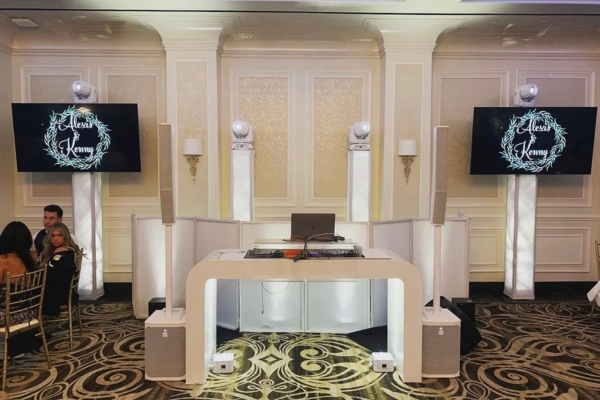
A wedding sound system should do much more than play music loudly from a pair of speakers beside the DJ booth. It supports nearly every major moment of the day, from the ceremony and vows to cocktail hour, introductions, speeches, live performances, and the dance floor.
The right setup depends on the venue, guest count, room layout, acoustics, entertainment, and how many different spaces are being used throughout the wedding. A ballroom, outdoor ceremony, tented reception, and multi room venue can all require very different approaches.
The goal is simple: guests should be able to clearly hear every important moment without ever having to think about the sound system making it happen.
What Makes Up a Wedding Sound System?
A professional wedding sound system is made up of several pieces working together. Speakers may be the most visible part, but microphones, mixers, audio control, power, cabling, and proper placement all play an equally important role.
Speakers and Subwoofers
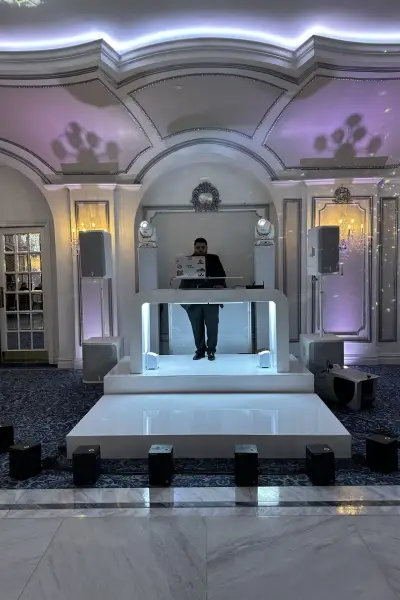
Main speakers handle most of what guests hear, including music, announcements, speeches, and other audio throughout the event. Subwoofers handle the lower frequencies that give music more depth and impact, especially once the dance floor opens.
More speakers do not automatically mean better sound, and neither does simply turning everything up louder. The system should be sized and positioned based on the room, number of guests, layout, and intended listening areas.
A smaller reception may need a relatively simple setup, while a large ballroom, tent, or venue with multiple sections may require additional speakers to create even coverage.
The goal is balanced sound. Guests close to the speakers should not feel overwhelmed while people farther away struggle to hear.
DJ Booth, Mixer, and Audio Control
The DJ booth is often the main control point for reception audio. From there, the DJ or production team manages music, microphones, announcements, live performers, and overall sound levels.
A mixer allows different audio sources to be controlled independently. Music can be lowered for an announcement, a microphone can be adjusted for a speech, and a live musician can be incorporated into the system when needed.
This control becomes especially important because a wedding does not stay at one volume all night. Cocktail hour, dinner, speeches, formalities, and dancing all require different levels and different types of sound.
Wedding Microphones
Microphones are essential whenever guests need to clearly hear someone speaking.
Wireless handheld microphones are commonly used for toasts, speeches, blessings, and MC announcements. Lavalier microphones can be useful during the ceremony because they allow an officiant or other speaker to talk naturally without holding a microphone.
The microphone itself is only part of the equation. Placement, audio levels, wireless frequencies, speaker positioning, and the way someone uses the microphone all affect how clear it sounds.
Backup microphones should also be available. A dead battery, wireless issue, or damaged microphone should not stop a ceremony or speech.
Professional audio teams also know how to position microphones and speakers in ways that reduce feedback and how to manage wireless equipment so different devices are not competing with one another.
Cables, Power, and Connections
The parts of a sound system guests never notice are often some of the most important.
Speakers, mixers, DJ equipment, microphones, and other production equipment all rely on stable power and reliable connections. Professional cabling also needs to be routed safely so it does not create a hazard for guests, staff, or performers.
Power requirements should be considered before the wedding, especially when sound is being used outdoors or alongside lighting, video walls, live instruments, and other production equipment.
A wedding sound system is ultimately an interconnected system. Every component needs to work together reliably rather than simply relying on a pair of powerful speakers.
Wedding Ceremony Sound
Ceremony audio is one of the easiest places for poor sound to become noticeable. If guests cannot hear the vows, officiant, readings, or music clearly, one of the most meaningful parts of the wedding can quickly become frustrating.
A ceremony sound system should prioritize clarity, reliable microphones, appropriate speaker coverage, and smooth music playback.
Making Sure Guests Can Hear the Vows
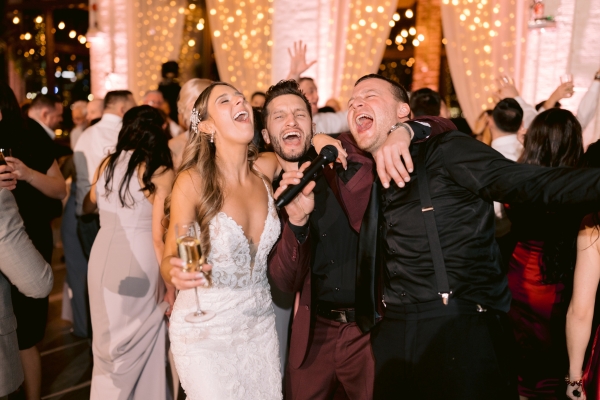
The officiant, couple, readers, and other ceremony participants may all need some level of amplification depending on the venue and guest count.
Microphone selection should fit the ceremony. An officiant may use a discreet lavalier microphone, while readings or other speakers may be better suited to a handheld microphone.
Placement matters just as much as microphone quality. The goal is to capture clear speech without forcing anyone to awkwardly lean toward a microphone or speak louder than they normally would.
Speaker placement also matters. Guests throughout the ceremony area should hear the vows comfortably without the people seated closest to the speakers being overwhelmed.
Ceremony Music and Live Musicians
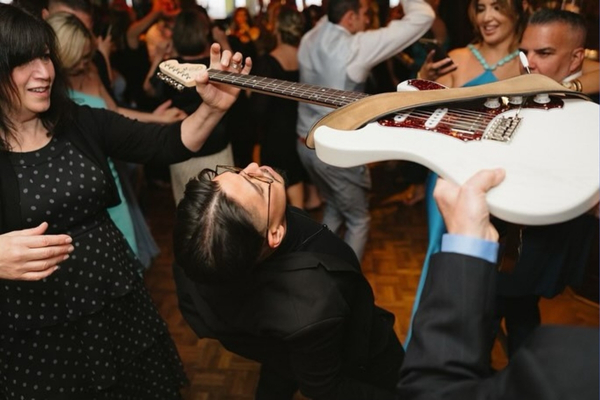
Wedding ceremony audio also includes all of the music surrounding the ceremony.
That may include music while guests arrive, the processional, wedding party entrance, the couple’s entrance, special ceremony moments, and the recessional.
Each cue needs to be ready, played at the correct time, and delivered at an appropriate volume.
Live musicians add another layer to the setup. Violinists, saxophonists, guitarists, singers, pianists, and other performers may need microphones, direct audio connections, monitors, or additional equipment depending on the venue and performance.
The sound system needs to accommodate those performers without making the ceremony feel overly produced.
Outdoor Wedding Ceremony Audio
Outdoor ceremonies require additional planning because sound behaves differently without walls and ceilings helping contain it.
Audio can dissipate quickly, especially across larger ceremony areas. Speaker placement becomes particularly important because the system needs to cover guests without simply becoming louder.
Wind can also affect microphones and make speech difficult to understand. Power may not be readily available near the ceremony site, and all equipment needs to be planned around possible weather exposure.
Venues may also have sound restrictions, volume limits, or specific rules about where speakers and equipment can be placed.
These issues should be addressed before the wedding day. Ceremony speakers, microphones, music playback, wireless equipment, and any live performers should be tested before guests arrive so problems can be corrected before the ceremony begins.
Sound for Cocktail Hour and the Wedding Reception
Once the ceremony ends, the role of the sound system changes.
Cocktail hour is usually about atmosphere and conversation. The reception then introduces announcements, formalities, speeches, dinner, and eventually a much more powerful dance floor environment.
A well planned system adapts throughout each part of the event.
Cocktail Hour Audio
Cocktail hour often takes place in a different room, patio, terrace, or outdoor area from the reception.
Because of that, it may require its own speakers and audio source rather than relying on the reception setup.
The goal during cocktail hour is not maximum volume. Music should create energy and atmosphere while still allowing guests to comfortably talk with one another.
If live musicians are performing, their audio requirements should also be considered. A saxophonist, guitarist, violinist, or small group may need amplification depending on the size and layout of the space.
Reception Announcements, Entrances, and Speeches
Clear speech is just as important as good music during a wedding reception.
The sound system may be responsible for wedding party introductions, MC announcements, blessings, toasts, special presentations, and first dance introductions.
These moments need to be understandable throughout the room, not just near the DJ booth.
Microphone quality, proper audio levels, speaker placement, and the acoustics of the venue all affect speech clarity. A microphone can sound great near one part of the room but become difficult to understand elsewhere if the overall system is not properly designed.
Professional sound also allows the DJ or production team to adjust quickly between different moments. Music may need to fade underneath an introduction, disappear completely during a toast, and return immediately afterward.
Those transitions should feel seamless to guests.
The Dance Floor
Once dancing begins, the demands on the sound system change again.
The main speakers need to deliver clean, energetic music at higher volume, while subwoofers add the low frequency impact that makes dance music feel full.
The goal is not simply to make the room as loud as possible.
Professional wedding sound should feel powerful without becoming harsh, distorted, or uncomfortable. Vocals should remain clear, bass should feel controlled, and the system should maintain quality even as the energy increases.
Sound should also remain balanced throughout the reception space. The dance floor should feel exciting without making seated guests across the room feel like they are standing directly in front of a speaker. Check out our dance floor rentals for further context.
Speaker Placement, Venue Acoustics, and Sound Coverage
Even high quality equipment can perform poorly when it is positioned incorrectly.
Speaker placement, room acoustics, guest seating, the dance floor, and the shape of the venue all influence how sound travels through a wedding space.
Why Speaker Placement Matters
One of the biggest mistakes in wedding audio is relying on volume to solve a coverage problem.
If every speaker is concentrated near the DJ booth, guests close to the system may hear too much while people farther across the room still cannot clearly hear a speech or announcement.
Proper placement creates more even coverage.
Larger or unusually shaped venues may require additional speakers positioned farther into the space rather than simply increasing the volume of the main system.
The same principle applies during the ceremony. Speakers should be positioned so guests throughout the seating area can hear clearly without drawing unnecessary attention away from the ceremony itself.
How the Venue Changes the Sound System
Every venue affects sound differently.
Traditional ballrooms may create reflections from walls, floors, windows, and high ceilings. Large halls can require additional coverage because of their size. Tents have their own acoustical characteristics and often require careful speaker and power planning.
Barns and industrial venues may contain hard surfaces that reflect sound throughout large open spaces. Outdoor venues allow sound to dissipate much more freely because there are no walls containing it.
Smaller reception spaces create the opposite challenge. A system that is too large for the room can overpower guests and make the experience uncomfortable.
Room dimensions, ceiling height, wall materials, guest seating, DJ booth location, and dance floor placement should all be considered when designing the system.
There is no single wedding audio setup that works equally well in every venue.
Weddings With Multiple Audio Areas
Many weddings take place across several different spaces.
The ceremony may be outdoors, cocktail hour may take place on a patio, the reception may be inside a ballroom, and an after party may move into another room entirely.
Each area can have different audio requirements.
In some cases, separate systems allow the ceremony, cocktail hour, reception, outdoor areas, and after party to operate independently with appropriate music and volume levels for each space.
This is why one pair of speakers beside a DJ booth cannot necessarily handle an entire wedding property.
Professional wedding audio starts with understanding where guests will be throughout the event and designing the sound system around the full experience rather than just the dance floor.
Why Professional Wedding Sound Requires Planning
A professional wedding sound setup should be designed around the event, not chosen from a standard package without considering the details.
Before deciding what equipment to bring, the production team should understand the guest count, venue size, floor plan, ceremony location, cocktail hour space, reception layout, dance floor, and DJ booth location.
Live musicians and performers also need to be accounted for. A saxophonist, singer, violinist, band, or other performer may need microphones, audio inputs, monitors, or additional equipment that must work with the rest of the system.
Microphone needs should be planned in advance as well. The ceremony, speeches, MC announcements, blessings, and live performances can all require different setups.
Power is another major consideration, especially when audio is being used alongside lighting, video walls, staging, or other production equipment. Outdoor weddings may also require a completely different approach to power and equipment placement.
The venue itself may have sound restrictions, curfews, designated equipment areas, or limits on where speakers can be positioned.
All of these details affect the final system. Professional wedding sound starts with understanding the event first and choosing the equipment second.
Sound Checks
A sound check should happen before the equipment is needed in front of guests.
Speakers should be tested throughout the space to make sure coverage is even. Microphones should be checked for clarity, proper levels, feedback, and wireless reliability. Music playback, live instruments, and any additional audio sources should also be tested.
If the wedding uses separate systems for the ceremony, cocktail hour, and reception, each area should be checked independently.
Sound checks give the production team time to identify problems while there is still time to solve them.
Backup Equipment
Even professional equipment can fail, which is why redundancy matters.
Backup microphones, batteries, cables, connections, and music playback options can prevent a small technical problem from becoming a major interruption.
The important difference is not that professional equipment never has issues. It is that an experienced production team plans for those possibilities and knows how to respond quickly.
When that planning is done correctly, guests may never even realize something went wrong.
Common Wedding Sound Problems and What Causes Them
Many wedding audio problems are preventable when the system is planned, positioned, and operated correctly.
- Guests cannot hear the vows.
Poor microphone selection, insufficient speaker coverage, or incorrect speaker placement can leave parts of the ceremony struggling to hear. - Microphones produce feedback.
Feedback can happen when microphones and speakers are positioned poorly or audio levels are not properly controlled. - Speeches sound muffled or unclear.
Poor microphone technique, incorrect audio settings, weak equipment, or uneven speaker coverage can make toasts difficult to understand. - Music sounds distorted.
Speakers pushed beyond their intended output can lose clarity and create harsh, unpleasant sound. - The dance floor is painfully loud while tables still cannot hear clearly.
This is usually a coverage problem rather than a volume problem. The system may need better positioning or additional speakers instead of simply more volume. - Wireless microphones cut out.
Interference, weak batteries, poor frequency management, or improperly configured wireless equipment can cause interruptions. - Cocktail hour has little or no sound coverage.
This often happens when all of the audio planning is focused on the reception and a separate cocktail hour space is overlooked. - Outdoor audio is difficult to hear.
Sound behaves differently outside. A system designed like an indoor ballroom setup may not provide enough coverage across an open ceremony or reception area.
These problems show why owning professional audio equipment is only part of the equation. The person operating it needs to understand how the entire system works.
Why the Wedding Sound Company Matters
Expensive speakers do not create great wedding audio by themselves.
The company behind the system needs to understand system design, speaker placement, venue acoustics, microphones, wireless equipment, power requirements, sound levels, live performers, multiple audio areas, troubleshooting, and backup planning.
That experience affects nearly everything guests hear throughout the wedding.
A knowledgeable production team can determine what equipment the venue actually needs rather than simply bringing the same setup to every event. They know where speakers should be positioned, which microphones make sense for different moments, how to integrate live performers, and how to balance sound across different areas.
They also know when a bigger system is unnecessary.
Professional audio is not about using the most equipment possible. It is about choosing the right equipment and designing the system around the wedding.
That becomes especially important when circumstances change. A ceremony may move indoors because of weather. A musician may need an unexpected audio connection. A microphone may stop working. A venue may require a last minute equipment adjustment.
An experienced wedding production company should be able to adapt without turning those changes into problems for the couple or their guests.
One Of A Kind Events approaches wedding audio as part of the complete event experience. The sound system is planned around the venue, entertainment, guest experience, and each part of the wedding rather than treated as an afterthought.
Planning your wedding entertainment and production? Contact One Of A Kind Events to build a professional audio setup around your venue, entertainment, and guest experience.
Wedding Sound System FAQs
How many speakers do you need for a wedding?
There is no single number that works for every wedding. The correct number depends on the guest count, venue size, room layout, dance floor location, acoustics, and whether the wedding uses multiple spaces.
A smaller ballroom may only need a simple main system, while a large venue, tent, or long room may need additional speakers to provide even coverage.
Do you need a subwoofer at a wedding?
A subwoofer is not required for every moment of a wedding, but it can make a major difference during the reception and dancing.
Subwoofers reproduce the lower frequencies that give dance music more depth and energy. The key is using them appropriately so the bass feels full without overwhelming the room.
Do you need microphones for a wedding ceremony?
In many cases, yes.
Microphones help guests clearly hear the officiant, vows, readings, and other ceremony participants. They become especially important for larger guest counts, outdoor ceremonies, and venues where natural speech does not carry well.
Does cocktail hour need a separate sound system?
It may if cocktail hour takes place in a different space from the reception.
A patio, terrace, separate room, or outdoor area may need its own speakers so music can continue while the reception system remains set up elsewhere.
The goal during cocktail hour is usually comfortable background music rather than high volume.
Do outdoor weddings require different sound equipment?
Outdoor weddings often require a different approach to speaker placement, coverage, microphones, power, and weather protection.
Without walls and ceilings containing the sound, audio can dissipate more quickly. Wind can also affect microphones, and power may not be available where equipment needs to be placed.
Does a wedding DJ usually provide the sound system?
Many professional wedding DJs provide sound equipment as part of their service, but what is included can vary significantly.
Couples should understand whether the setup covers only the reception or also includes the ceremony, cocktail hour, microphones, live performers, separate audio areas, and backup equipment.
For more complex weddings, a complete production approach may be needed rather than relying on a basic DJ speaker setup.